Friday, March 14, 2008
98,695


Thursday, March 13, 2008
Marcher Lord Press
Monday, March 03, 2008
Symphony of Secrets
 So I'm on a major Sharon Hinck kick, I guess. Finished reading The Restorer's Journey recently. And this morning, I finished reading Symphony of Secrets.
Like I said, I went to the gala opening a week ago. Jill read the book first and then passed it on to me afterwards. And this proved to be a fast, satisfying read as well.
Sharon Hinck puts together a very nice cozy mystery centered around concert flutist Amy Johnson. Amy is a single mother who finally gets her big break: she is able to join the Minneapolis Symphony. But then everything else spirals out of control. Her daughter, Clara, not only joins the (gasp!) cheerleading squad but she also starts to ask some uncomfortable questions about her father, ones that dredge up painful memories. Her friend, Lena, has converted to Christianity and is putting pressure on her to come to church (pressure that pops up in an unexpected way). And worst of all, the symphony is floundering as an unknown individual is out to sabotage everything. Amy does her best to deal with the mystery, but her efforts seem to only make things worse.
Amy is a prickly musician through and through. Like many of Sharon Hinck's characters, Amy feels inadequate in many of her roles. But unlike Sharon's other characters, Amy isn't a Christian. Not even close. She has definite First Commandment issues since she "worships" music as her god. The Christianity is not as blatant as in the Becky Miller or Restorer books but it is there.
One of the best things about this book is that I didn't see the solution coming. Well, that's not true. I had my suspicions, but Sharon created enough plausible suspects that I couldn't say for certain. The musician jokes added some spice to the story (and I especially appreciated the fact that the jokester was a trombone player. Man after my own heart). In short, if more Amy Johnson books come out, they'll be a great addition to the Sharon's pantheon of books.
Saturday, March 01, 2008
Time for a Writing Update
The Return of the Mourning Dove
I finished the first draft of this fantasy novel late last year (in September or October, if memory serves). I had put it on the shelf to let it cool so I could take an objective look at it and begin rewriting it. Because of the move to South Saint Paul, I have not had the chance to start on it yet.
But here's a picture of the manuscript in all 100,000 words of its glory:
 I really need to get to work on that soon.
The Last Expedition
I've mentioned my Christian sci-fi trilogy before. Well, I'm about two-thirds of the way through the first draft of version #3 of book 1. Confusing? Let's review.
I originally wrote The Leader's Song trilogy as one long book (easily 300,000 words long). When I realized that the sheer size would scare off publishers, I decided to chop it up into three books, namely The Rune Enigma, Exile, and Return to the Fold.
At the 2006 ACFW Conference, several people commented that there were structural problems with the books. I debated for a long time how to fix said structural problems and finally decided to tell the story in a linear fashion. The first two books would deal with what I've referred to as "the ancient story." The third book would tell the "modern story."
Back in January, I made a New Year's Resolution to write every day. And my first project would be the first volume in the rewritten Leader's Song trilogy. Since The Rune Enigma, the original title, referred to events in the "modern story," I scrapped it in favor of The Last Expedition.
In essence, this new version has three parts: The Conservatory, Target Four, and Target Ten. Target Ten is basically the last 30,000 words of The Rune Enigma and I figure I can save them with minor tweaks and updates to get everything to blend.
About two days ago, I finished work on The Conservatory portion. It clocks in at a little over 40,000 words. That leaves me with Target Four, which will hopefully be about 30,000 words long when I'm done.
The real problem is that I'm behind. I had hoped to have the entire project done at the end of February. Obviously I didn't quite make it. So now I'm upping my daily quota from "any writing" to "at least 1,000 words (preferrably 2,000)."
So there you go.
The Restorer's Journey

Thursday, February 21, 2008
JengaJam: The Aftermath
Grey Dog Software (with an "E," not an "A!" Great) - The home of Total Extreme Wrestling 2007, a great wrestling promotion simulator
SWF - This Means War! & MWA - This Means War! - The dynasties I write in connection with the aforementioned game
The Leading Edge Magazine - The first magazine to publish one of my short stories. And if their website wasn't currently broken, I'd post a link to the actual issue, but there you go.
Irruption in Dragons, Knights & Angels - My second published short story in all its glory.
Marcher Lord Press - The print-on-demand publishing company I mentioned and my only hope for getting my science fiction series published!
The Sparrow & Children of God by Mary Doria Russell - I mentioned these in the podcast and they're well worth the read. You can see my reviews here and here.
The various writings of Dr. Paul Maier - All of it good stuff
Books written by Sharon Hinck - Also very good stuff
The World's Last Night - Contains the essay "Religion and Rocketry," Lewis's musings on how Christianity and alien life forms would intersect
Till We Have Faces by C.S. Lewis - Fantastic book, very complex, very worth the read.
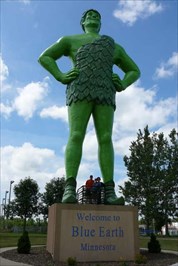
The Jolly Green Giant statue in Blue Earth, Minnesota - Just to prove it's real. I miss you, big guy!
A Few Good G-Men
Wednesday, February 20, 2008
Late Nite JengaJam

Indy!
All I have to say is, did anyone notice that the crate the black haired woman leaned over is labeled "Roswell?" As if Indy hasn't had enough stuff on his plate without crash-landed aliens as well!
Children of God

Sipaj, readers! Someone almost started crying in a Tires Plus this morning. That's how good this book is. Children of God is Mary Doria Russell's sequel to The Sparrow (which I loved) and she continues the stories started in that first book expertly. Father Emilio Sandoz is still trying to come to grips with what happened to him on the planet Rakhat. He's broken physically, emotionally, and especially spiritually. This Jesuit priest has given up on his faith, much to the consternation of his superiors. They can only come to one conclusion: Sandoz must return to Rakhat. Of course, given what happened to Sandoz, that's not exaclty an easy sell (and no, I won't say what happened to him. Read The Sparrow and find out for yourself!). In the meantime, life on Rakhat is undergoing a number of radical changes thanks to the Jesuit mission. Without realizing it, Sandoz and his compatriots set off a massive shift in VaRakhati society, tipping the balance between the Runa and the Jana'ata forever. You know that Sandoz will eventually go back to Rakhat. But what and who will be waiting for him when he returns? Once again, Russell employs a time-jumping narrative structure. One minute, we're in Naples in 2060. The next, we're back on Rakhat in 2042, shortly after the first Jesuit mission fell apart. Then we're at a point beyond the ending of the book, catching glimpses of what's about to come yet never truly seeing what Russell has up her sleeve. It takes a bit of getting used to, but Russell employs the scheme masterfully. Once again, my only gripe is with Russell's take on certain matters of faith. I seem to recall reading that Russell was an atheist who converted to Judaism mostly so her children would have a moral up-bringing. It's this background that maddened me when I read The Sparrow, since the Jesuits sounded more like Jewish rabbis than Catholic priests. She does a bit better in Children of God but not by much. As a result, I'm not certain I'm happy with the conclusions she draws at the end of the books. She seems to be asking the question, "Does God find us in the ashes?" And her answer would appear to be, "Who knows if He's even there out of the ashes?" Naturally I'm not too taken with that. But what almost redeems her effort is what almost got me crying in a Tires Plus, a statement that Father John Candotti makes at the very end of the book regarding Exodus 33:17-23. I won't go into details about it. I'd rather you discover it for yourself. But I will say this: regardless of Russell's faith (or lack thereof), that thought alone gave me much to mull over.
CSFF Blog Tour: The Shadow and Night Day Three

And so our look at The Shadow and Night by Chris Walley comes to an end.
One of the nice things about this blog tour is when your ideas are challenged a bit. Several people have commented on my confusion regarding the first sin that emerges with the arrival of evil. I have to say, though, that Steve Rice's post yesterday really got me thinking. This is what he said:
"Do you know what the book's first unimaginable act of wickedness is? It's a lie--a silly, trivial untruth that most of us would forget immediately. But here, it is an unthinkable breach of God's peace. It's followed closely by another departure that most of us wouldn't think wrong at all, though Walley's case against it is sound. Is it any wonder that in losing our horror of the small sins, it takes more and more sensational ones to stir us?"
After reading that, I realized that I had tripped over my own theological feet and should have seen that point for what it is.
That said, there's a fine line to be danced upon by writers of Christian fiction, because when you come right down to it, we have an odd, love-hate, symbiotic relationship with sin. Let's face it: you can't write good fiction without conflict of some kind. And where does conflict come from? That's right. Sin. Pure and simple.
But Rice made the good point, as did Walley. We should be just as horrified by the "small" sins as the "large" ones. Mea culpa, mea maxima culpa, I understand it now.
So go and see what other people are saying. I know I'll be going out to educate myself as well.
Brandon BarrJim Black
Justin Boyer
Grace Bridges
Jackie Castle
Carol Bruce Collett
Valerie Comer
CSFF Blog Tour
Gene Curtis
D. G. D. Davidson
Chris Deanne
Janey DeMeo
Jeff Draper
April Erwin
Marcus Goodyear
Rebecca Grabill
Jill Hart
Katie Hart
Michael Heald
Timothy Hicks
Christopher Hopper
Heather R. Hunt
Jason Joyner
Kait
Carol Keen
Mike Lynch
Margaret
Rachel Marks
Shannon McNear
Melissa Meeks
Rebecca LuElla Miller
Mirtika or Mir's Here
Pamela Morrisson
Eve Nielsen
John Ottinger
Deena Peterson
Rachelle
Steve Rice
Ashley Rutherford
Chawna Schroeder
James Somers
Rachelle Sperling
Donna Swanson
Steve Trower
Speculative Faith
Robert Treskillard
Jason Waguespac
Laura Williams
Timothy Wise
Tuesday, February 19, 2008
CSFF Blog Tour: The Shadow and Night Day Two
 So here we are, day two of our look at The Shadow and Night by Chris Walley. And, as promised, here's my review:
That may sound a little odd, especially coming from a poor parson such as myself. But I'll explain what I mean in a little bit.
Like I said yesterday, I was excited to read this book because it's science fiction. I'm still having a hard time identifying any "fantasy" elements in it (unless you count the heavenly messenger who shows up in the second book. Then maybe). That, along with what I said yesterday about the different eschatology, made this a fun read.Walley has a gift for prose and it really helped him out throughout the books. As we follow Merral D'Avanos and Sentinel Vero as they try to discover the source of evil's new outbreak and combat it on the distant world of Farholme, Walley carries us along with his superb verbal crafting.
It was interesting to watch how almost completely sanctified humans would deal with evil's return, how some of them embraced it whole heartedly, how others tried to fight it only to be corrupted anyway, and how some were repulsed by it yet still found it in themselves. While I wonder if "Satan's little season" would really start as a trickle, as Walley portrayed it, I thought that the snowball effect was well thought out and well portrayed.However...
Like I said, I was rooting for evil, especially in the first book. It wasn't that I wanted the forces of evil to win the conflict. I just wanted them to show up. Perhaps it's indicative of my fallen nature, both saint and sinner simultaneously, but I was getting a little antsy while I read the first hundred or so pages of The Shadow at Evening. I don't want to say it was boring while Merral investigated what was happening in Herrandown, but there were times when I had to force myself to keep reading and I would mutter, "Would evil just show up soon, please? I want some conflict!" It was only Walley's superb writing that kept me going.Pacing seems to be an issue for Walley throughout the book. He takes a very slow approach to things. Even in the second book, The Power of the Night, things proceeded rather slowly. When I saw how long it was, I expected a number of confrontations with evil. Instead, we got just one at the end.
Maybe it's a personal preference. Maybe Walley was going for a more cerebral journey. But it's just my opinion.I also took issue with some of the things that Walley considered "evil." For example, the first clear indication that evil returned seemed incredibly trivial to me. When I read what the sin was, I think I actually said, "That's it? Really?" Some of the sociological mores of the Assembly also seemed a bit odd as well. The courtship rituals, for example, didn't seem quite right to me. Much of what Merral went through in terms of romance seemed more intellectual than passionate. It just didn't ring true.
Now maybe that's just my own personal opinions tripping me up. But there you go. It's a good read if you don't mind a slow pace. And it certainly is thought provoking, if for no other reason than you get to play in another man's theological garden.The last thing I'll say is this: a good indication for me as to whether or not I liked a book or to what degree is really whether or not I'll go after a book's sequels. If I loved a book, I'll go out and purchase them right away. If I hated a book, I'll avoid it like the plague.
So what about this book? Well, I'm certainly keeping my eye out for The Dark Foundations, but I'm not in a rush to find them.Go off and see what everyone else has to say about this book:
Brandon BarrJim Black
Justin Boyer
Grace Bridges
Jackie Castle
Carol Bruce Collett
Valerie Comer
CSFF Blog Tour
Gene Curtis
D. G. D. Davidson
Chris Deanne
Janey DeMeo
Jeff Draper
April Erwin
Marcus Goodyear
Rebecca Grabill
Jill Hart
Katie Hart
Michael Heald
Timothy Hicks
Christopher Hopper
Heather R. Hunt
Jason Joyner
Kait
Carol Keen
Mike Lynch
Margaret
Rachel Marks
Shannon McNear
Melissa Meeks
Rebecca LuElla Miller
Mirtika or Mir's Here
Pamela Morrisson
Eve Nielsen
John Ottinger
Deena Peterson
Rachelle
Steve Rice
Ashley Rutherford
Chawna Schroeder
James Somers
Rachelle Sperling
Donna Swanson
Steve Trower
Speculative Faith
Robert Treskillard
Jason Waguespac
Laura Williams
Timothy Wise
Monday, February 18, 2008
CSFF Blog Tour: The Shadow and Night Day One
This month we're looking at The Shadow and Night by Chris Walley. I have to admit, this one excited me for the simple fact that it's clearly a science fiction book. I'm not sure why people classify it as "fantasy." I mean, you've got terraforming, genetic engineering, and faster-than-light travel. I saw nothing that could even remotely be construed as an elf or other fantasy-based races.
But before we go into the stories themselves, we should talk about their foundation, part of which is post-millennialism. This is a form of eschatology that doesn't get talked about all that often.For that very reason, I thought I'd do my civic duty by offering this, a millennial primer.
For starters, we'd better define our terminology. The "millennium" is the technical term for what's referred to in Revelation 20:"And I saw an angel coming down out of heaven, having the key to the Abyss and holding in his hand a great chain. He seized the dragon, that ancient serpent, who is the devil, or Satan, and bound him for a thousand years. He threw him into the Abyss, and locked and sealed it over him, to keep him from deceiving the nations anymore until the thousand years were ended. After that, he must be set free for a short time.
"I saw thrones on which were seated those who had been given authority to judge. And I saw the souls of those who had been beheaded because of their testimony for Jesus and because of the word of God. They had not worshiped the beast or his image and had not received his mark on their foreheads or their hands. They came to life and reigned with Christ a thousand years." (Revelation 20:1-4, NIV)I'm sure most of my readers are aware that there are about half a dozen different ways to interpret any passage out of Revelation, and that's certainly true of this passage as well. There are four basic "flavors" to millennialism, as illustrated by this chart:
 The first category is called post-tribulation premillennialism or is also known as "historic premillennialism." As you can see from the chart, those who hold this view believe that Christ's reign will be a literal thousand year reign that kicks off immediately after the tribulation.
The second category is, by far, the loudest. It's dispensational premillennialism. If you go to any Christian bookstore and grab a book on the end times, there's a very good chance that you'll have found a book written from this viewpoint. Truth be told, I've never seen a book that didn't hold this viewpoint in a Christian bookstore.
For that reason I won't go into too much detail here. Suffice it to say, dispensational premillennialists believe that before the tribulation, the Christian Church will be raptured into heaven. The tribulation will kick off, overtaking unbelievers, the Jewish people, and anyone who converts to Christianity afterwards (including the aforementioned Jews). After seven years, Jesus will return a second time (or would it be a third time?) to set up his literal millennial kingdom.
But then, if you've read Left Behind and the subsequent books, you're familiar with this already.
That brings us to postmillennialism. Unlike both strains of premillennialists, the postmillennialists believe that Christ's return will occur after the millennium. From what I understand, most postmillennialists believe that Christ's reign will be brought about by increasing Christian influence in society. Basically things will get better and better until humanity enters into a Christian utopia.
This is the eschatology that's at the foundation of The Lamb Among the Stars, of which The Shadow and Night is the first two books. In this case, Walley obviously doesn't see the millennium as a literal thousand year reign, seeing as the Assembly has lasted a dozen times longer than that.
And finally, there's amillennialism. I once saw an assertion by Tim LaHaye (obviously tripped up by the prefix a-) that amillennialists don't believe in a millennium at all. That's simply not true. Amillennialists do believe in the millennium. It's just that they believe that the millennium has already been ushered in at Christ's death and resurrection. The "thousand years" mentioned in Revelation 20 is taken to be symbolic, not literal.
In the interest of fairness, I'll confess here and now that I'm an ardent (some might even say militant) amillennialist. I don't buy into either version of premillennialism and I think postmillenialism is too optimstic. But this isn't a critique of Walley using postmillennialism in his book.Instead, I'm glad he did. Exploring a different theological viewpoint is always healthy. While I didn't agree with Walley on his eschatology, I certainly appreciated it and reading his stories helped me refine and hone my position a bit more.
So there you go. Millennialism. I don't know if anyone else will discuss that today. I won't bring it up tomorrow either. Well, probably not. Instead, I'll submit some reviews on the stories themselves. In the meantime, be sure to check out what other people are saying:
Brandon Barr
Jim Black
Justin Boyer
Grace Bridges
Jackie Castle
Carol Bruce Collett
Valerie Comer
CSFF Blog Tour
Gene Curtis
D. G. D. Davidson
Chris Deanne
Janey DeMeo
Jeff Draper
April Erwin
Marcus Goodyear
Rebecca Grabill
Jill Hart
Katie Hart
Michael Heald
Timothy Hicks
Christopher Hopper
Heather R. Hunt
Jason Joyner
Kait
Carol Keen
Mike Lynch
Margaret
Rachel Marks
Shannon McNear
Melissa Meeks
Rebecca LuElla Miller
Mirtika or Mir's Here
Pamela Morrisson
Eve Nielsen
John Ottinger
Deena Peterson
Rachelle
Steve Rice
Ashley Rutherford
Chawna Schroeder
James Somers
Rachelle Sperling
Donna Swanson
Steve Trower
Speculative Faith
Robert Treskillard
Jason Waguespac
Laura Williams
Timothy Wise
Thursday, February 14, 2008
How Evil Are You?
| You Are 30% Evil |
 A bit of evil lurks in your heart, but you hide it well. In some ways, you are the most dangerous kind of evil. |
Wednesday, February 13, 2008
Tuesday, February 12, 2008
The Restorer's Son
 I would have posted this review earlier, but as you can see, I had to fight to get my hands on the book.
 Wednesday, January 23, 2008
CSFF Blog Tour: Auralia's Colors Day Three
I have to admit, I was a little nervous about making this post. If you looked in the comments, you'll see that my identification of the Keeper as some sort of Christ or God figure might be a little off. That made me a little gun shy for today.
See, when I read Auralia's Colors, there was something that was said in a climactic scene that irked me. Just a little. But as time passed and the blog tour drew nearer, it bothered me more and more. And so I planned this post to address what it was and why those statements tainted what, up until that point, had been a very enjoyable read.
But because of my "oops" yesterday, I decided I had better go back and reread the scene to make sure I wasn't going to make another mistake. So last night, I did just that. And discovered that, much to my chagrin, it wasn't as bad as I remembered.
And yet I'm going to make the post anyway because, even though the problem is not as blatant as I remembered, there were hints of a serious eschatological mistake.
To explain, let me present you with a hypothetical situation.
Let's say that a tornado rips through your town. This isn't some mini-twister. This is one of those F5 monsters, the kind that happen once in a great while. Everything is completely destroyed and everyone in your neighborhood is out on the streets.
Fortunately for you, a wealthy philanthropist hears about your plight. More than that, he's filled with compassion and wishes to do something. And so, purely out of the kindness of his heart, he decides to rebuild your hometown. Every last house. Every last building. He'll foot the bill and make everything right again.
But more than that! He's not just going to rebuild the houses. He's going to make them better. Every house will have an indoor heated pool. Every house will have plush master bedroom suites. Every house will have spacious kitchens with granite countertops. You get the idea. Again, he will pay for the upgrade and, even better, there will be no mortgage payments or utility bills or anything like that.
Now obviously, this will take some time so, in the interim, he'll put you and your neighbors up in a hotel. A nice one. You know, four stars, good room service, free cable, that sort of thing.
Great news, yes? I'm sure that in light of all this, you would be quite excited. So you call your friends and tell them, "Guess what? I get to stay in a HOTEL!" And that's all you talk about. The four stars. The room service. The cable. Not a word about the new house.
Does that seem reasonable? And yet far too many Christians celebrate the hotel, not the house.
What am I talking about? And how does this relate to Auralia's Colors? It all has to do with what we believe happens to us after we die.
The problem is, far too many Christians suffer from what I call "interim state confusion." They believe that heaven -- specifically the disembodied soul part -- is the final destination. But if you read the New Testament carefully, you realize that disembodied souls in heaven is not the hope we have as Christians for after death. The resurrection of our bodies is the true hope.
Think about it. How did Jesus comfort Martha when Lazarus died? He didn't point her to heaven. He pointed her to the resurrection. What did Paul spend 58 verses expounding on in 1 Corinthians 15? It wasn't heaven. It was the resurrection. How did Paul comfort the Thessalonian Christians when some of their siblings in the faith had died? It wasn't by pointing them to some ethereal, eternal heaven. It was by assuring them that the dead would be raised in glory at the Last Day.
Heaven, properly understood, is the waiting room, not the end of the story as so many assume. It's the interim state but so many people confuse it for the big deal.
So what does this have to do with Auralia's Colors? There's a moment where, in a climactic scene, Overstreet dips his toe into interim state confusion.
I don't really want to say where; it will kind of ruin a major plot point and, in spite of my red warning yesterday, I don't want to generate this massive of a spoiler. But at one point, Overstreet makes it sound as if our bodies are simply something to be discarded after death and that this physical world is somehow unimportant.
That's simply not true. Worse, it's not really a Christian attitude. Think of it this way: God did not create human beings as bodiless souls that somehow got tricked and trapped into a physical body when we fell into sin. He created us soul and body together. Death does violence to that natural order and separates the two. That's why the resurrection is all important. It will reunite what was never meant to be divided.
To put it bluntly, the belief that the physical body doesn't matter is, in my opinion, borderline gnosticism. The gnostics believed that physical matter was inherently evil and that the soul had to be freed from it. While this attitude of the body being an unimportant husk doesn't reach that level, it does trivialize something that God has created and God doesn't create junk.
My ranting and raving about this does not mean that I didn't enjoy Auralia's Colors. I did. And like I said, Overstreet may not have intended to cross the line and may not have at all. I'm all for Christian speculative fiction authors dancing on the end of tree branches (as is evidenced by my rampant speculation about alien life from a few months ago). We just have to be careful that the branch we're dancing on is still on the tree.
But enough from me. Sorry. Like I said, interim state confusion is a pet peeve of mine and I tend to sound off on it when I can. Go and peruse the other participants. I'm willing to guess none of them will smack you upside the head with a theology lecture.
Brandon Barr
Jim Black
Justin Boyer
Grace Bridges
Jackie Castle
Carol Bruce Collett
Valerie Comer
CSFF Blog Tour
D. G. D. Davidson
Chris Deanne
Jeff Draper
April Erwin
Marcus Goodyear
Andrea Graham
Jill Hart
Katie Hart
Timothy Hicks
Heather R. Hunt
Becca Johnson
Jason Joyner
Kait
Karen
Carol Keen
Mike Lynch
Margaret
Rachel Marks
Shannon McNear
Melissa Meeks
Rebecca LuElla Miller
Mirtika or Mir's Here
Pamela Morrisson
Eve Nielsen
John Ottinger
Deena Peterson
Rachelle
Steve Rice
Cheryl Russel
Ashley Rutherford
Hanna Sandvig
Chawna Schroeder
James Somers
Rachelle Sperling
Donna Swanson
Steve Trower
Speculative Faith
Jason Waguespac
Laura Williams
Timothy Wise
Tuesday, January 22, 2008
CSFF Blog Tour: Auralia's Colors Day Two
SPOILER ALERT: The best example of this is the Keeper. Unfortunately, I had this surprise ruined for me by a review on Amazon, so I kind of saw it coming. But I'll be honest, I thought it was cool. The way Overstreet presents it, the Keeper is the beastie who lurks in people's dreams, an uncontrollable monster that the people of Abscar seem to rightly fear but has some unexplainable connection to Auralia. But, as the story unfolds, we realize that the Keeper is not a horrific monster but, surprise surprise, a rough analogue to God. Or Christ. I'm still trying to put all the pieces together to figure out which precisely. Although, come to think of it, the distinction isn't as clear as I just made it sound.
Sorry about the tangent. Anyway... The Keeper. I have to admit, I had never envisioned Christ as a big monster that lurks in the bottom of a lake. Let's face it, when most people think of Jesus, the picture Him like this: Very friendly, very serene. Not at all a monster.
And yet, the reason why we think of Him that way is because we know the end of the story. When we do walk with Jesus on the roads of Galilee and Judea, we do so knowing that He's heading to the cross and the empty tomb. We know who He is and what He is. We know what His motivation is and why He does what He does (for the most part). We don't see Jesus as a monster because to us, He's not.
But then, we don't suffer from "the scandal of the immediate," as Dr. Paul Maier calls it. Like I said, we see Jesus and we see Him as the loving Messiah, the one sent to redeem the world. But that's not how the first century Jewish leadership saw Him. To them, He was a monster and a scary one, best eliminated and forgotten about. To the Pharisees, He was a sinner who encouraged people to break the covenant law, putting them in double jeopardy. Not only might they be punished for impiety with another exile, the Messiah might never arrive as well.
To the Sadducees, Jesus was a rabble rouser, a potential rallying point for those who wanted to disrupt the status quo with the Romans. If things were allowed to go too far, the Romans would have to quash the rebellion, which could result in the Sadducees losing power and the center of their existence, the Temple.
To both, Jesus was a monster. He had to be eliminated. The only reason why we don't see Him that way is because we see Him through the lens of faith. Since we know the end of the story, since we have that relationship of faith, we don't see Him that way. We see Him as the "tame" Messiah with the loving heart in the same way that Auralia and Cal-raven see the Keeper.
The important thing, I guess, is to remember the not-so-tame Messiah. After all, to rip off C.S. Lewis a little, the Keeper is not a tame beastie. But he is good. And so is Christ.
Be sure to check out what the rest of the blog tour participants are saying:
Brandon Barr
Jim Black
Justin Boyer
Grace Bridges
Jackie Castle
Carol Bruce Collett
Valerie Comer
CSFF Blog Tour
D. G. D. Davidson
Chris Deanne
Jeff Draper
April Erwin
Marcus Goodyear
Andrea Graham
Jill Hart
Katie Hart
Timothy Hicks
Heather R. Hunt
Becca Johnson
Jason Joyner
Kait
Karen
Carol Keen
Mike Lynch
Margaret
Rachel Marks
Shannon McNear
Melissa Meeks
Rebecca LuElla Miller
Mirtika or Mir's Here
Pamela Morrisson
Eve Nielsen
John Ottinger
Deena Peterson
Rachelle
Steve Rice
Cheryl Russel
Ashley Rutherford
Hanna Sandvig
Chawna Schroeder
James Somers
Rachelle Sperling
Donna Swanson
Steve Trower
Speculative Faith
Jason Waguespac
Laura Williams
Timothy Wise
Monday, January 21, 2008
CSFF Blog Tour: Auralia's Colors Day One
 This month we feature Auralia's Colors by Jeffrey Overstreet. Simply put, this book was phenomenal. I thoroughly enjoyed it (except for one point, but I'll talk about that on Wednesday. It's kind of a long story).
The book is the story of Auralia and starts when she is found by the river by two former criminals. And so we're plunged into a rich and detailed world, one in which colors have been outlawed in the House Abscar. This is problematic for Auralia, who has a talent for finding rich and vibrant colors in the world around her. What will happen when Auralia flouts the royal law by using her natural talent?
Overstreet's narrative simply sings throughout the whole book. I noticed at several points that he engaged in a great deal of "telling" (which, as most writers will tell you, is a major no-no). But he was able to get away with it because his prose was spot-on perfect. I didn't mind the "telling" at all. In fact, it was a joy to read.
Exploring Auralia's world was fantastic as well. Overstreet's creation had great depth to it with its own cultures and history. It was foreign enough to fascinate yet familiar enough to not overwhelm.
And then there's the Keeper. But I'll talk more about him tomorrow.
To sum it up, this is a fun, beautiful read. Make time for this one. You'll be glad you did.
Be sure to take a look at what others have to say:
Brandon BarrJim Black
Justin Boyer
Grace Bridges
Jackie Castle
Carol Bruce Collett
Valerie Comer
CSFF Blog Tour
D. G. D. Davidson
Chris Deanne
Jeff Draper
April Erwin
Marcus Goodyear
Andrea Graham
Jill Hart
Katie Hart
Timothy Hicks
Heather R. Hunt
Becca Johnson
Jason Joyner
Kait
Karen
Carol Keen
Mike Lynch
Margaret
Rachel Marks
Shannon McNear
Melissa Meeks
Rebecca LuElla Miller
Mirtika or Mir's Here
Pamela Morrisson
Eve Nielsen
John Ottinger
Deena Peterson
Rachelle
Steve Rice
Cheryl Russel
Ashley Rutherford
Hanna Sandvig
Chawna Schroeder
James Somers
Rachelle Sperling
Donna Swanson
Steve Trower
Speculative Faith
Jason Waguespac
Laura Williams
Timothy Wise
Thursday, January 03, 2008
Doink doink!
I have been a fan of the original Law & Order for quite some time now. I remember getting hooked by one of their infamous "ripped from the headline" cases, one based ... er, ripped from the story of JonBonet Ramsey. There have been highs. There have been lows. Lately there have been new cast members every time I blink. But I have remained faithful for one reason: Jack McCoy.
 Jack McCoy (played so ably by Sam Waterston) is the man! I love this guy. I love the clever way that he traps defendants on the stand. I look forward to his closing arguments. I savor his gruff demeanor in the office. He is the sole reason I've endured the revolving door casting on this show.
When Fred Thompson announced his candidacy (or whatever it is he's supposed to be doing in Iowa), I was delighted. Not because I wanted Fred Thompson to run for president. Primaries aren't my thing. No, I was excited because I realized that, thanks to the equal time rule, Arthur Branch would be gone from the "big chair" and, based on some of the hints dropped in the last season, there was a very real possibility that Jack would finally ascend to become not just the executive District Attorney, but the main man himself.
And imagine my delight when, on a recent episode of Law & Order: SVU, I learned that it had happened. Alexandra Cabot is called on the carpet by the new DA. And I was thrilled! Sure, Jack wouldn't be prosecuting cases anymore, but it would be fun to see him with even more on his plate.
And my delight kept growing. Thanks to the writers' strike, Law & Order returned to its rightful slot on Wednesday night! And it was a two hour premiere! What a deal for me!
I have to say, by and large, I was satisfied with what I saw tonight. Two very good episodes with some fun twists to them. But all is not well in my fanatic little brain. I have a major gripe with the way Dick Wolf reshuffled his cast. And it has to do with Jack McCoy's staff.
 I assumed, when I learned that Jack McCoy had become the head cheese (how many more synonyms can I come up with in one post?), Connie Rubirosa (played by Alana de la Garza) would get bumped up to first chair in terms of prosecution. Now that would be something. The original Law & Order has never had a female chief prosecutor before. Sure, SVU has, but not the original. I was actually looking forward to seeing Rubirosa drill into a defendant and do more than just run on down to the precinct when she was needed to listen in on an interrogation.
Besides, Rubirosa's promotion would also dispel a nasty notion that I've had in the back of my head for a few years now. It would prove that Dick Wolf doesn't have it in for female prosecutors. Let's see here: he's killed two of them (Claire Kincaid and Alexandra Borgia), almost killed another (Alexandra Cabot), had one savagely beaten (Casey Novak), and had one come out of the closet completely at random (Serena Southerlyn). To have Connie Rubirosa actually go up instead of crashing and burning like the majority of the female ADAs in his shows would have been kind of cool.
 But no, that didn't happen. Instead, Wolf brought in the new guy, Michael Cutter (played by Linus Roache).
Now, don't get me wrong. I liked what I saw. Roache resembles a somewhat gaunt Michael Douglas and his accent is really cool. His energy seems to be a good counterpoint for McCoy's demeanor and I like the fact that he ordered the cops in without a warrant (watch the reruns). And the way he clinched the case against the kidnapers was almost McCoy-esque. But would it have been so horrible for Cutter to be the ADA and let Rubirosa take the lead chair?
But I guess that isn't going to happen. Oh well. In the meantime, I'll get used to seeing Michael Cutter on cross. I'll delight in seeing Jack McCoy calling the shots. And I'll hope that Connie Rubirosa keeps her life insurance premiums paid up.

 Posts
Posts