Pages

Sunday, November 26, 2006

Fragile Things


Early, early this morning I finished reading Fragile Things by Neil Gaiman. It's another collection of Gaiman's short stories and poetry and, as always, it left me feeling a little jealous. This man has undeniable talent when it comes to writing. It's little wonder that he continues to hop onto the bestseller lists; if anyone deserves to be there, it's Gaiman.

That isn't to say that everything Gaiman did was perfect. His take on the Chronicles of Narnia, The Problem of Susan, ticked me off to no end. I saw the ending coming in How to Talk to Girls at Parties. There were a few stories and poems that left me scratching my head.

But by and large, Gaiman is a mster of his craft. I loved A Study in Emerald. Forbidden Brides of the Faceless Slaves in the Secret House of the Night of Dread Desire, while a finger-twisting title, really made me laugh out loud. Seeing as I majored in theatre in college and for a senior year project directed a play based in commedia dell'arte, I felt right at home reading Harlequin Valentine. And The Monarch of the Glen was a worth addition to the American Gods canon.

But the biggest surprise was, by far, Goliath.

If you've read Gaiman's collections of short stories, you know that he always has notes about the stories in his introduction. He explains his inspiration, that sort of thing. After reading Smoke and Mirrors, I decided that in the future, I would avoid reading those notes until after I've read the story. There were a few cases where the notes ruined the ending for me and I wanted to avoid that this time around.

Anyway, I read Goliath with a certain amount of frustration. It was clear that Gaiman was ripping off a very popular movie (or so I thought) and I wondered how he could have done such a thing. Then I went back and read the notes and realized that he didn't actually rip off said movie; instead, he was asked to write a short story for said movie's website.

That's all I'm going to say. Read the short story yourself to see which one it is. You'll figure it out within the first page or so.

Anyway, good read, as always when it comes to Gaiman. I may not always appreciate his philosophy (and definitely not his theology), but he always gives me something to think about and shows me how woefully inadequate my own writing is.

Wednesday, November 22, 2006

Musings on NaNoWriMo

So earlier this morning, I crossed the 40,000 word mark on my NaNoWriMo novel. That felt pretty good, so I thought I'd stop and share some thoughts about this whole experience.

I'm not sure if I'll ever be able to sell this book or not. It's a convoluted mess right now. I've already mentally highlighted half a dozen places I'll need to go back and shore up. Or I may just have to put the perfect finishing touch to this story when I'm done. Namely a match.

At the same time, though, I've learned some things about myself and my writing:

1) I needed the structure and the deadline. I've been very lacksadaisical about my writing for the past year. I'd type in a few words every now and then if I felt like it and usually, I found myself playing World of Warcraft or some other computer game rather than writing. But now, thanks to NaNoWriMo, I've been forcing myself to get up earlier and start the day by writing at least 1,500 words. It's a good discipline that I'm hoping to carry past just this one month.

2) I really, really, really need help on crafting good characters. One of the critiques that I got regarding The Leader's Song was that I needed stronger characters. Writing this novel has made me realize how true that is. I bought a book recently that hopefully will help, but if anyone has any ideas on how a plot-oriented writer like me can learn how to make fresh and vivid characters, please let me know!

You know, I know I learned more than that. Huh. Oh well. At any rate, even with taking two (maybe three) days off for Thanksgiving, I should be able to hit the finish line by the end of the month. I don't think the book will be done yet, but at least I've benefited from this experience.

Happy Feet

Last night Jill and I went to see the CGI movie "Happy Feet" and, I have to say, I was impressed ... sort of.

To be honest, the only reason I wanted to go was to see the rapping baby penguin from the commercials. I knew that bit would take all of half a second (and I was right), but I was pleasantly surprised.

For starters, we have the music. I can't imagine how much the producers must have spent to get the various licenses for all of that music. It was woven through the plot pretty well and often had Jill and I doubled over with laughter, simply because we couldn't believe what they came up with next. Just to give you an idea: in the first minute or so of the film, you'll hear a penguin imitating Marilyn Monroe singing Prince's "Kiss". Not what I expected in a kid's movie at all, but it made me sit up and take notice.

The vocal talent was top notch. Very well done. If I didn't know that it was Hugh Jackman playing Memphis, I would have never guessed. And Robin Williams did a pretty good job as Ramon (although I question the intelligence of the writers making the shorter penguins all Latino stereotypes).

The only problem I had with the movie was the rather bizarre plot. If you've read anything about the movie, you know that the plot basically boils down to this: most penguins sing to find their mates, but one penguin named Mumbles is unable to sing. Instead, Mumbles can dance, but that's discouraged as being "unpenguin". So on the surface, the plot is typical children's movie: be yourself in spite of what others say, yada yada yada.

But then there's a rather odd subplot (or main plot, I really couldn't tell) tacked on about aliens. Yes, you read that right. Aliens. It was pretty funny when it was introduced but as this plot becomes more and more important, things just become stranger and stranger. The last twenty minutes of the movie just didn't feel right to me. It had a deus ex machina feel to it.

I think the problem is that the writers wanted the audiences to think about a serious issue at a children's movie and so they tacked on the serious message at the end of the plot and then bludgeoned us over the head with it repeatedly. It kind of detracted a little.

But overall, not a bad movie and if you're planning on going, I wouldn't stop. Just be ready to stare disbelieving at the screen because of the music.

Monday, November 13, 2006

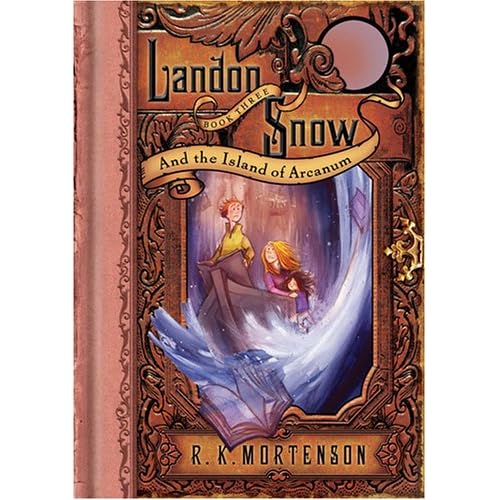
CSFF Blog Tour: R. K. Mortenson's Landon Snow and the Island of Arcanum

CSSF Blog Tour


Good grief, is it blog tour time again already? The days just sneak past you, y'know?

This month's tour is centered around R. K. Mortenson's Landon Snow and the Island of Arcanum. Sadly, I have not read this book and I doubt I could locate a copy of it before the end of the tour on Wednesday. So I'll offer this as a cop-out. Ain't this a nice cover?


Okay, so that's a lousy cop-out. Be sure to visit the other participants. I'm sure they'll have done their homework.

Jim Black
Jackie Castle
Valerie Comer
Frank Creed
Gene Curtis
Chris Deanne
April Erwin
Kameron M. Franklin
Beth Goddard
Todd Michael Greene
Leathel Grody
Karen Hancock
Katie Hart
Sherrie Hibbs
Sharon Hinck
Joleen Howell
Jason Joyner
Karen and at Karen¹s myspace
Oliver King
Tina Kulesa
Lost Genre Guild
Kevin Lucia
Rachel Marks
Shannon McNear
Rebecca LuElla Miller
Caleb Newell
John Otte
Cheryl Russel
Hannah Sandvig
Mirtika Schultz
Stuart Stockton
Steve Trower
Speculative Faith
Chris Walley
Daniel I. Weaver

Friday, November 10, 2006

Fallen from Babel


This is sort of momentous for me. This review marks the last book that I brought back from Dallas and the ACFW Conference. 'Course, that doesn't mean that I won't be reviewing books anymore. I have since spent a bit of money to create a whole new stack of books to read. And my lovely wife brought home Neil Gaiman's latest collection of short stories because she heard me mention once that I like his writing. I have a good wife.

Anyway, all that aside, earlier this afternoon I finished reading T. L. Higley's Fallen from Babel. In this gripping story of time travel, Professor Peter Thornton finds himself transported from 21st Century Boston to ancient Babylon during the time of the Jewish exile. He finds himself inhabiting the body of a priest named Rim-Sin and finds himself interacting with Daniel, Shadrach, Meshach, and Abednego.

Higley does a marvelous job bringing ancient Babylon to life. There were many times where I was tempted to stop reading and do some digging into Babylonian culture myself, not because I wanted to check facts, but because it piqued my interest.

Higley also constructed her story that it kept me reading and kept me surprised. I was never sure exactly what was going to happen and there was one point where I definitely did not see a twist coming. It felt really, really good to be utterly surprised.

My one minor complaint is something that sometimes pops up in Christian fiction, and that's what I would call the "leap of spiritual maturity" problem. To put it as vaguely as I can without giving anything away, sometimes in Christian fiction, new converts are somehow given an extraordinary amount of spiritual maturity right out of the box, which often strikes me as a little untrue. This happens at the end of this book; I'll let you see if you can figure out what I'm talking about.

But this is still a fantastic book and I'm looking forward to reading more.

Wednesday, November 01, 2006

CSFF October Blog Tour -- Day Three of DKA

CSSF Blog Tour


And so we come the end of the October Blog tour.

Once again, I went to Dragons, Knights, and Angels Magazine and read one of their current short stories. This time I chose Dragon...Knight...Angel by Genevieve Cunningham. It's listed as a student entry, which is something that I think is fantasitc. I've noticed when heading over to DKA in the past that they have student entries. It's wonderful that younger writers are being given the chance to shine.

On to the story itself. It was a great concept of a broken down knight going out to battle a dragon. But why is the dragon even there? I think Genevieve put together a great story and should be proud of herself.

Two bits of criticism, though. In some cases, I thought things got a little wordy. Those of you who have seen my unpolished writing will know that this is a case of the pot calling the kettle black. If it can be said in five words, I tend to say it in twenty (or more). Maybe that's why I noticed it.

The other critique I have is that the story wrapped up a little too quickly. There was a bit of a deus ex machina at the end where everything was explained to a bewildered Reycott. If Reycott had made part of the cognitive journey himself (specifically, if he had tried to fight the dragon but found that he couldn't beat it), the sewing up of loose ends would have sat better with me.

But hey, it's easy to arm-chair quarterback, and I know that. Again, Genevieve Cunningham is another name I'm going to be watching out for.

Make sure you visit the rest of the blog tour participants:

Jim Black
Jackie Castle
Valerie Comer
Frank Creed
Christina Deanne
Beth Goddard
Rebecca Grabill
Todd Michael Greene
Leathel Grody
Karen Hancock
Elliot Hanowski
Katie Hart
Sherrie Hibbs
Sharon Hinck
Joleen Howell
John Otte
Jason Joyner
Oliver King
Tina Kulesa
Kevin Lucia
Rachel Marks
Shannon McNear
Rebecca LuElla Miller
Cheryl Russell
Mirtika Schultz
James Somers
Stuart Stockton
Steve Trower
Chris Walley
Lost Genre Guild
Speculative Faith

Tuesday, October 31, 2006

CSFF October Blog Tour -- Day Two of DKA

Once again, I went to Dragons, Knights, and Angels and read one of the short stories in their current issue. This time, I chose Plaque by ct matthews.

The reason I chose this one stems back to the ACFW conference. At the conference, John Olson told us the story of how one of his first manuscripts he tried to sell was a Christian vampire story. Needless to say, I was a bit curious as to how to even produce a Christian vampire story.

Well, that's exactly what CT Matthews has written and, for the most part, does a pretty good job. There's not a lot of action to the story, but at five pages long, that's to be expected. He also came up with an interesitng twist to how Christians and vampires would interact. I especially appreciated the communion hymn at the end of the story. Very nice touch.

That being said, there were three things that bothered me about this story.

The first is the title. I think Mr. Matthews intended to title his story "Plague", not "Plaque". It's a minor thing but still...

The second two things had more to do with history and theology. The first is the statement that Cain was Jewish.

That may seem like an odd thing to quibble about, but it's actually one of my pet peeves. It's historically inaccurate to refer to someone as Jewish if they died before approximately 587 BC. That's because, historically, nobody was called a Jew until after the people of Judah returned from the Babylonian Exile. Then they're called Jews. Before that point, they were called Israelites, children of Israel, or Hebrews.

It's not even right, really, to refer to Cain as a member of the Chosen People either, since the whole "Chosen People" business didn't get started until Abraham, who lived many centuries (maybe even millennia) after Cain died.

To put it in modern terms, you wouldn't refer to the ancient Maya in Mel Gibson's upcoming movie as "Mexicans", even though they lived and died before Mexico was even formed as a country. It's just sloppy, historically speaking.

The second thing that threw me off was the statement that Jewish people couldn't be turned into vampires yet converts to Judaism could. That just doesn't seem right to me.

Anyway, perhaps the reason why I'm being so picky is because, ultimately, I enjoyed this story and I hope to see more from Mr. Matthews. This guy's got potential.

Once again, don't forget to visit the other members of the Blog Tour:


Jim Black
Jackie Castle
Valerie Comer
Frank Creed
Christina Deanne
Beth Goddard
Rebecca Grabill
Todd Michael Greene
Leathel Grody
Karen Hancock
Elliot Hanowski
Katie Hart
Sherrie Hibbs
Sharon Hinck
Joleen Howell
John Otte
Jason Joyner
Oliver King
Tina Kulesa
Kevin Lucia
Rachel Marks
Shannon McNear
Rebecca LuElla Miller
Cheryl Russell
Mirtika Schultz
James Somers
Stuart Stockton
Steve Trower
Chris Walley
Lost Genre Guild
Speculative Faith

See you tomorrow for the last day of the tour!

Monday, October 30, 2006

Double Vision


I just now got done reading Double Vision by Randall Ingermanson. For those of you unfamiliar with Mr. Ingermanson, he's written a few novels in the past. He also puts out a monthly e-zine and has a ton of info on the craft of writing. I took his intermediate writing course at the ACFW conference (and missed most of it due to editor and agent appointments).

After reading Double Vision, I've come to the conclusion that every aspiring writer should spend a little time at the feet of Randall Ingermanson.

This is an extremely well written book. It's the story of a man named Dillon Richards, a brilliant computer programmer with Asperger's syndrome. Dillon has been put to work with a young woman named Rachel Meyers, a genius biophysicist who has invented a quantum computer, a device that, once it's working, would be able to either break every conventional encryption program or create an unbreakable code. The problem is, someone wants the quantum computer and are willing to do just about anything to get it.

As if that wasn't bad enough, Dillon finds himself torn between Rachel and another woman, named Keryn Wills. Keryn and Rachel couldn't be more different from one another and both have designs on Dillon's heart.

I don't want to say much more than that for fear that I'll start dropping spoilers.

But like I said, this was an extremely well written novel. I especially appreciated the different voices that came out with each character. Especially Dillon. Mr. Ingermanson did a marvelous job of creating a unique voice for Dillon, one that gave me a peek into his world.

Go get this book! Now! Follow the link above and you won't regret it.

CSFF October Blog Tour -- Dragons, Knights, and Angels

CSSF Blog Tour


I got in on this a little late last month, but I'm ready and rarin' to go this month. Sort of. Be gentle, I've never done a full tour before.

This month's victim ... er, target is Dragons, Knights, and Angels Magazine. This is an on-line magazine dedicated to Christian Science Fiction and Fantasy. Truth be told, I have a short story brewing that will likely wind up in their submission box sooner or later (that is, if I ever get my posterier in gear and finish it).

One of the stories that caught my attention in this month's issue was An Epitaph for Shangri La. It was an interesting read about a group of space explorers who find a seemingly idyllic paradise only with no inhabitants. The mystery of what happened to the people of Shangri La is slowly revealed through the story as the people from Earth try to piece it all together.

I'll be honest, I'm not sure if I liked this entirely. It was a thinly veiled critique of modern society. It raised valid points, but a little more subtlety could have made it a truly excellent, kick-you-in-the-gut story.

Anyway, I'll be posting links and thoughts about other stories in the current issue over the next couple of days. Be sure to check out the other sites in the tour:

Jim Black
John J. Boyer
Jackie Castle
Valerie Comer
Frank Creed
Bryan Davis
Christina Deanne
April Erwin
Beth Goddard
Rebecca Grabill
Todd Michael Greene
Leathel Grody
Karen Hancock
Elliot Hanowski
Katie Hart
Sherrie Hibbs
Sharon Hinck
Joleen Howell
John Otte
Jason Joyner
Oliver King
Tina Kulesa
Kevin Lucia
Rachel Marks
Shannon McNear
Rebecca LuElla Miller
Cheryl Russell
Mirtika Schultz
Stuart Stockton
Steve Trower
Chris Walley
Lost Genre Guild
Speculative Faith

Monday, October 23, 2006

Adrenaline


Earlier today, I finished reading Adrenaline by John Olson. This is one of the books I picked up at the ACFW conference, so you know it's a Christian book.

It's the story of a biochemistry student named James Parker. Parker is researching possible cures for muscular dystrophy, a disease that has him confined to a wheelchair and is threatening to kill his sister. He believes he's found a cure in an adrenaline-based drug, but his life becomes complicated when he rescues a young woman named Darcy from a group of drug addicts.

Parker and Darcy are soon plunged into a life-threatening adventure as they try to learn if the drug really works. The problem is, mysteries keep cropping up, more than I can really explain here.

I'll be honest, I'm not exactly sure what I think of this book. It was exciting and well written, but I think the plots were so densely layered that I got a little lost every now and then. Olson piles on the mysteries and conundrums, almost to the point where the plot gets bogged down in places.

It was a good read that got my attention for two reasons:

1) It wasn't what you would call an explicitly Christian book. While Parker and his family are Christians, there isn't a lot preaching in this book. They were quietly Christian. Moreover, Olson never beats anyone over the head with the faith stick. That's not a bad thing; it was a pleasant change after reading a few books where the faith stick was overused. There's really nothing wrong with writing a story where Christianity is more of an underlying, subtle factor, not an overt, end-all and be-all of the story.

2) It was definitely a sci-fi book. You can label it "mystery/suspense", but it's still sci-fi. Adrenaline 355 (or "Mighty Mouse", as it comes to be called) is something straight out of sci-fi. Read the book and you'll see what I mean.

Friday, October 13, 2006

The Wedding Caper


The Wedding Caper by Janice A. Thompson is the last complimentary copy book I received at the ACFW conference and I just finished reading it this morning.

The title lists it as a cozy mystery, and it certainly is that. But I also get the feeling it could be classified as some sort of "chick-lit". Granted, I'm not entirely familiar with the chick-lit genre, so I could be waaaay off, but there you go.

Annie Peterson finds herself thrust into a mystery: where did her husband get $25,000 to pay for her twin daughters' weddings? Is it possible that he's responsible for the burglary at the Clark County Savings and Loan? Annie, using insight she gains from an on-line sleuthing course, tries to unravel the mystery while at the same time dealing with two weddings, a hyperactive dachsund, and a husband who she's not sure she can trust anymore.

Thompson is a talented writer. The characters were fresh and memorable and she displays a great deal of wit throughout the story. That being said, I didn't enjoy it that much. That's not a knock on Thompson; it's just a genre-related thing. I'm a fantasy and sci-fi type of guy; a cozy mystery with strong chick-lit overtones just doesn't do anything for me.

The only other thing that bothered me is that Thompson loads up the story with Christian themes and elements. It was almost too much for me. This especially was the case with the numerous deus ex machina moments throughout the story. Things came together a little too easily at times and it didn't really ring true for me.

But hey, that's just my opinion. For someone who loves cozies, this book would probably be wonderful. It's just not my cup of tea.

Thursday, October 12, 2006

I NaNoWriMo. Do You?

I've heard about it, but I never thought I'd do it myself. But hey, I've been sort of in a slump for writing new material, so I figured a high-velocity motivation and a good firm deadline might be a good thing for me.

So I signed up to do NaNoWriMo, or National Novel Writing Month. For the month of November, my goal will be to bang out a first draft of a new 50,000 word novel before midnight of November 30th.

Will I make it? I have no earthly idea. But it should be a fine try.

But the question I have for all of you .... do you have the guts to join me?

Tuesday, October 10, 2006

The Shoes Have Dropped

I have heard back from both Andy Meisenheimer and Steve Laube and, as I kind of expected, I have been turned down by each.

On the up side, they weren't mean or nasty (not that I expected them to be). They also had some helpful comments. Mr. Laube suggested that I work on characterization. This has always been weakness for me. I'm more of a plot-oriented writer.

Mr. Meisenheimer commented on the structure of the story, so I'm thinking that some kind of rewrite is definitely in the cards. Now I just have to decide how to do that. The way I see it, I have two options:

Option #1 - Divide the two stories (modern and ancient) into their own separate books - We've talked about this before, so I won't go over it again.

Option #2 - Intertwine the two plots in a sort of every-other chapter format. If I were to go with this option, after a chapter of the modern story, we would shift into the ancient story, and then back to the modern, and then back to the ancient. This would blend the two together. I would have to craft things in such a way that there were parallels between what's happening in the present and what's happening in the past and I kind of have an idea of how I can pull it off. I've even seen it done well in Spock's World where Diane Duane intersperses a story of Captain Kirk trying to prevent Vulcan from seceding from the Federation with tales of Vulcan's history.

While this could be an intriguing way to do things, I can already see two problems brewing:

For starters, this would require an even more massive rewrite of the modern storyline, more so than if I just divided the ancient and modern stories into their own separate books. We're talking a complete revamp of the characters, the backstories, everything. I'm not saying that it can't be done. I'm not saying I wouldn't do it. I'm just saying that I'm not sure how it would turn out.

Second, and more importantly, maintaining the momentum of the ancient and modern storylines would be even more difficult (as Mir pointed out in her comments). Right now, the modern storyline comes to a screeching halt when the ancient storyline takes over. That's not good. At the same time, though, if I were to interweave the two together, the modern storyline and the ancient storyline would both come to "rolling stops" at the end of each chapter. Instead of one massive "slam on the brakes" moment, we'd have lots of little stops.

As Mir also pointed out, the temptation then would be for the reader to just stick with one storyline and skip the chapters from the other. For example, in Spock's World, when I re-read it, I tend to skip over the chapters about Vulcan's history and just read the story with Kirk and McCoy and Spock and so on. I may go back and read my favorite parts of the history, but by and large I just ignore it.

To craft a story like this would take incredible skill, something I'm pretty sure I don't have. I suppose I could try it and see how it goes, but I'm thinking it'll just wind up an even bigger mess than when I started.

At any rate, I'm thinking the best thing to do right now with The Leader's Song is to follow the advice of my wonderful wife and one of my crit partners. It'll go on the back burner for a few months so I can let it cool and then approach it from a more objective standpoint.

Of course, then the question is, what do I work on in the interim? Do I continue to brand myself as a sci-fi/fantasy writer or do I branch out into other domains? Huh.

Sunday, October 08, 2006

Sands of Time

Another free book from the ACFW conference down, one to go.

While the book cover describes this as a "thriller", I would say what the spine says is slightly more accurate: "a romantic suspense". Don't get me wrong, the plot, involving smuggling enriched uranium from a former Soviet republic is definitely thrilling, but that plot is secondary to the love story at the heart of this book between FSB agent Roman Novik and missionary Sarai Curtiss.

Sands of Time would appear to be an installment in a series of books with these characters. There were many references to action that took place in the past, so much so that I had the feeling I should be more familiar with them. Don't get me wrong, Susan May Warren does an exemplary job getting the reader up to speed; I really didn't need to read the former books. She brings in the backstory in ways that don't overwhelm the current plot.

It turns out that Roman and Sarai have a history together. She left him thirteen years prior due to Roman's choice of career. Now a coup in Irkutia brings them back together. What information does Sarai have that makes Governor Bedlov want her dead? And can Roman protect her when she is convinced she doesn't need a hero?

Take what I'm about to say with a grain of salt. After all, I'm a guy who just read what is essentially a romance novel, even if it is one with some pretty decent action. The book was enjoyable. I really appreciated what Warren had to say about the Christian vocation (the tension between Sarai and Roman over his career as a soldier highlighted the issue nicely), but Sarai bugged me. A lot. She struck me as very unreasonable at times. Not only that, but the ending felt a little too pat for my tastes. Things got wrapped up a little too quickly. Again, this might be because of that's the way romantic suspense is written; I just wanted a little more action.

If you're into romantic suspense, you probably can't do better than Sands of Time.

Thursday, October 05, 2006

The Leader's Song's structure - Three or Two?

As if the strange fork-in-the-road I'm facing regarding genres isn't enough, I also have been debating the structure of my sci-fi trilogy, The Leader's Song. In some ways, it might need a massive overhaul to its structure. In other ways, it might be fine the way it is.

Here's the deal. I mentioned my one-sentence summary in a previous post: "A pastor unearths an alien who is searching for grace." That both describes the first book and the overall plot of the trilogy very well. My problem is this: there's both a modern part of the story and a part that spans centuries of ancient history.

Currently, the trilogy is structured like this:
  • The Leader's Song: The Rune Enigma -- The modern story starts. About half-way through the book, everything shifts. The modern story is put on hold so the ancient story can unfold.
  • The Leader's Song: Exile -- The ancient story resumes where it left off. There is a break to hop back into the modern story about halfway through before going back to the ancient story. When the ancient story winds down, the modern story takes over again.
  • The Leader's Song: Return to the Fold -- The last book follows the modern story to its end, but major pieces of what happened in the ancient story color what happens from here on out.

I know those descriptions are kind of generic, but hey, I don't want to give away the entire plot for free, do I?

So you probably see my dilemma. I start the modern story, I put it on pause so the ancient story can play out, then resume the modern story again.

Why did I structure it like this? Well, a couple of reasons. First of all, when I first wrote this story, I wrote it as one long book. After I finished, I realized that it was simply too long and had to be divided up into three parts.

Second, I thought this structure might be a good way to "ease" the reader into the world I created. Rather than just dump them into a world with aliens, I thought I would slowly reveal what's going on ... and then dump them into a world with aliens.

Third, this is the way the idea kind of unfolded for me when I was brainstorming and I never really questioned the way it was.

So why am I questioning it now? Well, as I was getting ready for the ACFW Conference, one of the things I did was get a paid critique from Jeff Gerke of my novel proposal. Mr. Gerke has served as an editor at various Christian publishing houses and is known as an advocate and champion for sci-fi and fantasy. He was very helpful but one of the things he commented on was the structure of my trilogy. He thought it was a bit convoluted. Instead, he suggested dividing the two stories into separate books: the ancient story and the modern story.

A few other people have commented that it might be better to do that as well. A few have said that it's silly to try to ease the reader into the story since it's almost like I'm trying to hide the fact that aliens are involved, something that will be boldly proclaimed either in the cover art or on the back cover copy. I can see where these people are coming from and I've even put some thought into what I would have to do to restructure everything. It could be done.

So why am I so hesitant to do it? A couple of reasons:

First of all, while people have said I should restructure, just as many people have said to leave it the way it is. That's part of my confusion right there.

Second, if I were to restructure, it would wreck big chunks of the modern story. Part of the modern story includes a mystery that could shake Christianity to its very core. A sthe ancient story plays out, it kind of tweaks the mystery a little before a big shocking reveal at the end of the second book (which sets up a nice cliffhanger that I hope is very "Luke, I am your father"-ish). If I restructure the book, the mystery loses its oomph because the reader will know what's going on, thereby taking the teeth out of part of the plot. To be honest, it's what the restructuring would do to the modern story that makes me hesitate the most. I'm not sure how it would play out or even if it could as well as it has.

Third, I'm a little lazy and am scared by the amount of work that would go into the rewrite. There, I said it. This doesn't mean that I wouldn't do the work if I think it'll help; I will. I'm just hesitant to expend all that effort if it isn't really necessary.

I suppose I'll just have to wait and see what Steve Laube and Andy Meisenheimer have to say about it. I'm still waiting to hear from them and probably will be waiting for a while. That's okay. It'll give me more time to mull it all over.

Wednesday, October 04, 2006

More ACFW Ruminations

Turns out it wasn't that I hit the word limit for the blog. I ran into some HTML problems that I don't fully understand. Oh well.

Anyway, on with my ACFW ruminations.

Third, I was amazed at how God was ready to give me little boosts throughout the conference. For example, after finding out that Bethany House is closed to sci-fi, I was feeling pretty glum. Part of it was a death of a dream -- for six years now, one of my daydreams has been to add to Bethany's impressive sci fi resume with my own trilogy. It was kind of hard to see that dream die. Part of it was also frustration with myself for not doing my homework and wasting one appointment. So as I'm feeling blue and rather down on myself and my story, I walked into my Early Bird appointment.

The Early Bird session at ACFW was a definite plus. Colleen Coble and Deborah Raney led this session. Basically the idea was that authors could send them their works-in-progress and have them critique what they were doing. Then in the actual session, we would discuss each others stories and brainstorm about how to pump up the conflict, where to take the stories, that sort of thing. Some of us signed up for small group brainstorming sessions and mine was on Friday afternoon.

So there I am, trudging into hospitality suite 1239, feeling pretty down on myself and my writing. I sit down and the first words out of Deborah and Colleen's mouths were, "We loved this story!" It perked me right up and kept me going.

The same sort of thing happened on Saturday. I had a paid critique with Bryan Davis. He basically "bled all over" the first twelve pages of my book and pointed out some problematic areas. But he too liked the concept of the story and our chat was a great boost for me.

Fourth, I now find myself at a sort of crossroads. Sort of. The one thing I took away from the conference about the current Christian market is the fact that it's pretty much closed to sci-fi. That's not to say that it'll be closed forever but it certainly is right now. That seems to be the bad news. The good news is that while very few Christian publishing houses are looking for fantasy, they won't automatically slam their doors to it either.

So what do I do? I have a Christian sci-fi trilogy, The Leader's Song, that is pretty much complete (the second and third books need some hammering; the first, just some polishing). I've been mulling over another sci-fi book that I'm tentatively calling The Dragon's Heart. While at the conference, I had another sci-fi idea that needs quite a bit of work but could be fun. So I guess on the one hand, I can continue to write books that may never sell.

On the other hand, I do have one or two fantasy ideas that aren't Christian. I've been mulling over one of them for two or three years now and I think I may be ready to start writing it soon. I wish there was some way to inject some Christianity into it, but honestly, I'm not sure how I could. I do have an idea for a fantasy trilogy but that still needs quite a bit of brainstorming to get ready and I'm a bit hesitant to do that.

On the third hand, part of me thinks the way to go is to ditch sci-fi and fantasy for a while. I started a speculative biography about Joesph Caiaphas about a year ago that kind of petered out. I also recently had an idea for a murder mystery set in Slovakia that could be kind of fun (but may not work; it depends upon what conditions in Slovakia were like during the Communist regime). I figured maybe I could make a shift into some different genres, try to get published there, and then go back to sci-fi if/when I become a more established writer. The problem with this is simple: I only have these two non-sci-fi/fantasy ideas. What do I do after these?

I'm really not sure what to do. Do I continue to stumble down the sci-fi path? Do I hop over to the fantasy path? Do I do a complete 180 and go down a path I've never really traveled before? Hmmmm. Well, if you're a reader of my blog or just stumbled on it on your way to something more interesting, please feel free to leave a comment or a suggestion.

Tomorrow I may post another dilemma I've been dealing with lately, namely the structure of The Leader's Song trilogy.

More ACFW Thoughts

I've been keeping track of what others have written about the ACFW conference, especially reading the day-by-day (almost blow-by-blow account) of my conference mentor Shannon McNear (I'm even mentioned twice in her accounts). Now that it's been almost a week and a half since I've gotten home and I've caught up on my sleep, I figured maybe I would share some more thoughts about it all.

I'm not sure why I haven't been giving it more thought. I think part of it is that the minute I got back to Blue Earth, there was a ton of things to deal with (a parishioner about to cross the Jordan, Jill's best friend's wedding to attend, the usual rigamarol of being a pastor, plus that big "other issue" in my life that I'm still not prepared to discuss at length). I had to dive back into my somewhat regular routine with both feet and haven't had a lot of down time to really process through what I went through. Now, though, let's see here.

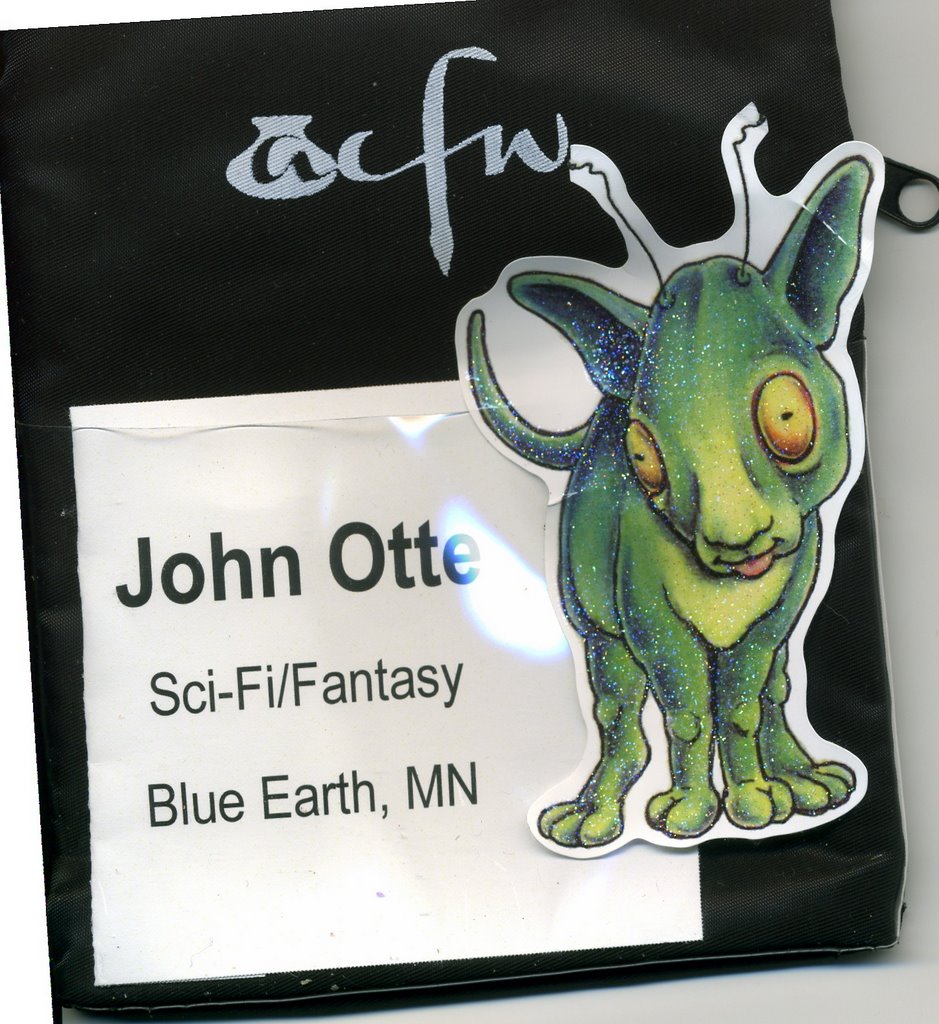
For starters, I'm definitely not sorry that I went. It was a very good, very uplifting experience. Like I said before, it was heartening to see that there were a lot of fantasy and sci-fi writers out there trying to crack open the Christian market. Maybe not as many as the romance or mystery writers, but it seemed like every day, more and more of us came out of the woodwork. I even stumbled over a few. Or, rather, they sought me out. Perhaps it's because, as Shannon said, I'm TALL and I was wearing this around my neck:


Second, in some ways, the conference was a bit discouraging. But I guess that goes hand-in-hand with writing sci-fi and fantasy. The good news that I kept hearing is that some publishing houses are beginning to open ever-so-slightly to fantasy. The bad news is the same isn't happening with sci-fi.

Why is that a big deal? Well, let me share the pitch line I had printed on the back of my snazzy business cards:

"A pastor unearths an alien who is searching for grace."
See the problem? Yeah, me too. My encounters with editors and agents was not always encouraging. Dave Long from Bethany House informed me that Bethany was pretty much closed to sci-fi. Steve Laube said that the market was pretty much closed to it as well, although I enjoyed our chat as he shared some stories about the Firebird trilogy.

Now, all is not lost. I was able to send a proposal for said book (actually, for said sci-fi trilogy) to Steve Laube and Andy Meisenheimer of Zondervan and I'm waiting for their replies. I have a feeling it'll be "Thanks, but no thanks", but that's okay. At least I'm in crash position for it.

I seem to have hit my blog's outer limits for length. Tomorrow, more thoughts and maybe I'll even post about the writing dilemma I seem to be facing post-Conference.

Embrace Grace

Another free book from the ACFW Conference down, two more to go (plus the three that I actually bought). Yes, I have a stack of books in my den that are calling me to read them. Heck of it is, I even bought two more this past weekend. I know, I know, it's a sickness!

But on to the book, Embrace Grace. It was good. How's that for a review? Ha!

In all seriousness, I looked forward to reading this book after hearing Liz Curtis Higgs speak at the ACFW conference. She was phenomenal. Lots of humor, lots of insight, plus a few details that I'm going to steal for sermons in the future. Yes, every pastor does it. It's just that not all of us admit to it.

Grace is essentially a book written about the conversion experience. It encourages the reader to embrace doubt, faith, truth, sin, forgiveness, repentance, and grace as they move from a state of unbelief and "lost in sinness" into a forgiven lifestyle.

I really enjoyed what I read. The chapter that surprised me the most was "Embrace Sin". Just the title alone caught me off guard, but as I read it, I remembered the old Martin Luther quote that we snotty Lutheran pastors like to throw around ... "Sin boldly!" Liz basically repeats what Martin said so many years ago. Hey, truth is truth.

What made me chuckle was when I was in line to get my copy signed by Liz. She asked who the book was for and I said it was me. She smiled at me and told me to ignore the fact that when she addresses the readers, she refers to them as women. And, as a rule, she does. I told her I didn't mind, especially since the New Testament basically contains nothing but references to "brothers". I figured turn-about is fair play!

So there you have it. It was a good book and a quick read. Always two good qualities.

Thursday, September 28, 2006

Violet Dawn


Normally I wouldn't read a mystery. It's just not my style. But there were several reasons why I read this one. For starters, I got it for free. Yes, I know, that's a lousy reason to read a book, but it was a definite factor. I got it when I registered at the ACFW conference along with a few other books in genres I normally don't venture into. As odd as it sounds, once I get a book, I tend to make sure to read it, even if I normally wouldn't, even if the experience isn't that good.

Not to worry, though, Violet Dawn by Brandilyn Collins was a joy to read. It had me hooked from the beginning, when poor Paige Williams finds a dead body in her hot tub, to the last page where ... well, you really don't expect me to give it all away, do you? I mean, if finding a dead body in your hot tub isn't enough to get you reading, then I don't know what will.

Honest to goodness, this book was in my hand just about every chance I had. When I was playing yet another game on Civilization IV, I had only one eye on the screen. As I was watching TV, I wasn't really paying attention, I was hip deep in Kanner Lake, trying to figure out what was going to happen to poor Paige. It really helped that Brandilyn kept the chapters short. Short chapters always sucker me into reading a book; I always wind up muttering, "Just one more, just one more."

What really got my attention, though, is that this book is a little different from other Christian fiction I've read. Most Christian fiction includes, for lack of a better term, a "come to Jesus" moment, where one of the non-Christian characters ... well, comes to Jesus. You know what I mean. Or, if that doesn't happen, the spiritual aspects of the story are basically right there in the foreground. I'm not saying that either of these things are bad. Given the way I write Christian fiction, I'd be a hypocrite to say that it was.

That's why Brandilyn's subtlety with Christianity was kind of a refreshing change. A few of the characters in the book are Christians. There is an over-all Christian theme to the book. But we're not beaten over the head with it. It made for a fun, breezy read.

So will I venture back to Kanner Lake? More than likely, I will. I mean, it was a great town to visit. I think it'd be fun to go back again.

Oh, and of course, I can't forget one of the main reasons why I read this book first (since I came back from ACFW with seven books). The reason is S-Man. A minor character in the book, but a really cool and awesome guy in real life. Stuart, thanks for letting a newbie tag along with you for so much of ACFW.

Monday, September 25, 2006

Plague of Terror


I really wanted to like this book. I really, really did.

I mean, this book was written by an LCMS pastor. I thought that was really cool because it's my dream to become a published LCMS pastor as well. But the more I read Plague of Terror, the more disappointed I became.

The premise of the story was interesting: terrorists release a fast-acting virus upon an unsuspecting world, pitching everyone and everything into chaos. The book itself follows three siblings, a doctor, a radio DJ, and a pastor, as they try to deal with this horrific plague and manage falling in love. There's the added mystery of a strange man that pops in and out of their lives.

In many ways, this book reminds me of Ted Dekker's Circle Trilogy and Frank Peretti's two angel books. To put it bluntly, Dekker and Peretti do it better. This was not an enjoyable read. If nothing else, Anderson's book taught me a few things about writing Christian fiction:

1) Show, don't tell. You hear this a lot in writing books. At least, I have. Now I understand why it's so important. In many cases, Anderson tells us about things. He doesn't show us through what his characters do or say. It made it boring to read.

2) Watch your Point-Of-View. Anderson had us jumping inside one person's head and then into another person's head and then into a sort of omniscient narrarator P.O.V. It made the book less enjoyable. Rather than see the world through the eyes of one character at a time, you never knew whose eyes we'd be looking through.

What really got frustrating was the times that Anderson "pulled back the curtain", so to speak, to allow us to see what was happening on the spiritual plane between angels and demons. He could have learned a lesson from Frank Peretti on this. Peretti did it right: when he shifted into the spiritual realm, he broke from the scene he had been writing. This allowed the readers to make the shift with him and it wasn't jarring when angels or demons popped into the story.

Anderson doesn't do that. We'll be going along, following people in the moral plane, when suddenly BAM! There's a paragraph out of nowhere about what the angels are up to. But then we're back with the humans again immediately afterward.

Another thing that Anderson could have learned from Peretti would have been to give the angels and demons names and personalities. As it was, I didn't really care. As a matter of fact, I think he could have just as easily cut all the scenes from the supernatural P.O.V. and the story would have been better.

Which brings us to the next point...

3) If it doesn't move the plot forward, cut it. I mentioned that there were three siblings in this book, right? Only two of them related to the main plot of the story, namely the doctor and the pastor. Both had major parts to play. The radio DJ and her love interest contributed very little the main storyline about the virus. Once I finished reading the book, I seriously questioned why she was even included in the story at all.

Actually, there seemed to be a lot of unnecessary padding in this book. There were scenes that were tossed in there for seemingly no reason. In one case, I thought that something truly horrible had happened to one of the heroes, only to have him pop up a couple chapters later and be just fine. In another case, there were some scenes set in Iran that didn't really seem necessary.

I could go on, but you get the idea. It wasn't a bad concept; it was just executed poorly. Hopefully Anderson's future efforts will be better.

There's more of us than I realized!

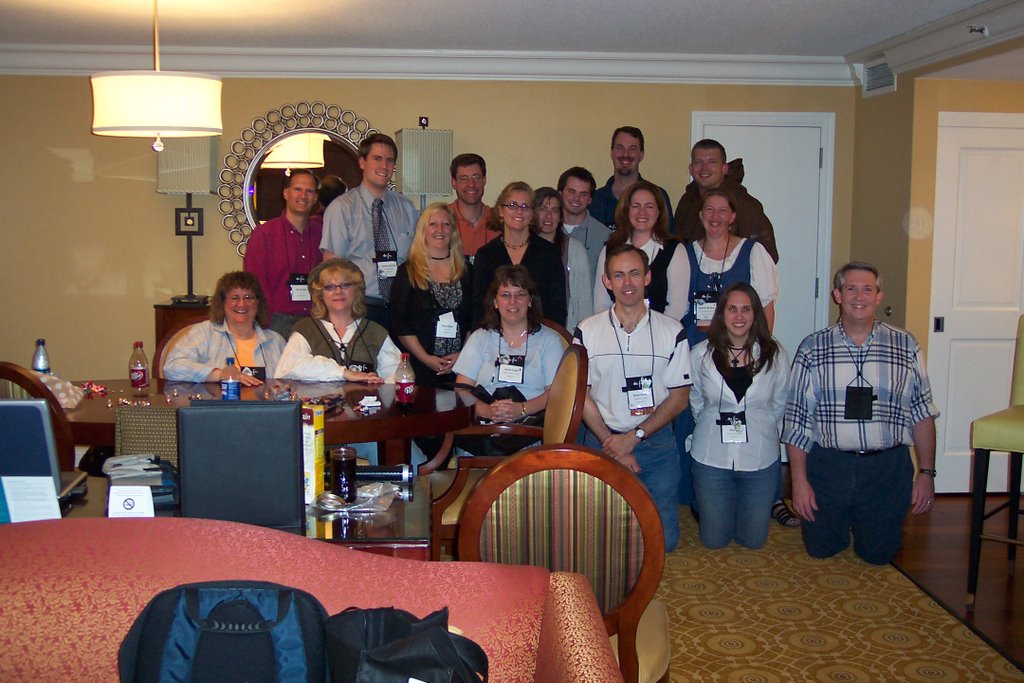
One of the nice things about going to the ACFW Conference is that I realized there were a lot more of us sci-fi/fantasy writers than I realized. Here's a picture we took at our Thursday night get-together:

The really cool thing is that sci-fi and fantasy writers kept popping out of the woodwork as the conference progressed. It's good to know there's more of us out there!

The ACFW Conference

So late last night, I got back to Blue Earth from the American Christian Fiction Writers' annual conference in Dallas. All in all, it was a good experience. I went to several classes that were very helpful, but there were some things I learned about writing and about myself:

1) Make sure your information is up-to-date. One of the things you can do at the ACFW conference is go to appointments with editors from various Christian publishing houses. I signed up for one, hoping to pitch my Christian sci-fi trilogy. I figured it would be a good fit with the house in question because they had a track record of publishing Christian sci-fi and fantasy.

Boy-howdy, was I wrong.

Turns out my information was several years out of date. The editor who championed the sci-fi books I enjoyed reading had left long ago to become an agent. Therefore the house wasn't looking for sci-fi and was closed to it. So I basically wasted that appointment. Thankfully the editor was very polite about it and offered a few suggestions about what to do, but it still kind of stung, especially since it was my own fault. Oh well. Live and learn.

2) Don't burn your bridges. I actually learned this from observing someone else.

I made another mistake at the conference. I approached the wrong guy with my pitch (not the editor I mentioned in number one) and he politely told me he wasn't interested. A few nights later, a bunch of us were sitting around chatting in the hotel lobby and this individual joined our group. He then mentioned that several people had approached him with their pitches and then made fun of us for doing so. Needless to say, I was a little torked that he did that.

So I learned a lesson: you never know who is going to overhear the negative things you say or who might stumble into a blog. That's why I'm not saying who this individual is. Let's just say that even if he eventually wanted to work with me, I would not want to work with him.

3) I'm definitely a traditionalist when it comes to worship. Meaning that I have to have a liturgy and traditional hymns if I'm going to consider it worship. Enough said about that.

4) I hope I can go back to ACFW again next year. I had a blast at the conference. I made some new friends, got to connect with people I only knew from their blogs or the ACFW forums, and even garnered a few compliments for my writing (which really helped buoy me up, especially after learning lessons #1 and #2).

In short, while it's good to be home, I'm really glad that I went.

Sunday, September 17, 2006

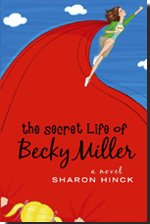
The Secret Life of Becky Miller


I never thought in a million years that I would read a "chick-lit" book. I would have never guessed that I would enjoy it either.

I figured that I would take a look at The Secret Life of Becky Miller after I heard about its LCMS connection. Yes, denominational loyalty goes a long way with me. I wasn't sure what I would find exactly. I had never read chick-lit or "Mom-lit" before.

The story was instantly engaging. Becky Miller is a stay-at-home mom who is trying desperately to stay ahead of the game. She's trying to balance three young children (one of whom has health issues), her husband's work woes, her somewhat eccentric friends, and especially her desire to do Big Things for God. Unfortunately, Becky's plans never seem to work out quite like she planned. For every step she seems to take toward her goal, she's forced to take several backwards. For every door that God closes, it seems like He slams shut two windows. It seems like whenever Becky hits rock bottom, she's tossed a shovel and told to keep digging....

I trust you get the idea.

Hinck weaves several threads through the overall plot: Becky's desire to work full-time for her congregation's women's ministry, an impending article for Women of Vision magazine, just to name two. The chapters are short which is a definite plus, seeing as I was always tempted to "read just one more, read just one more" (hence why I finished this in a day and a half). Hinck's writing made me laugh out loud on more than one occasion and yes, I even teared up on two occasions (get to the twist toward the end and see how dry-eyed you remain, those who judge me!).

Will I read any chick-lit again? I'm guessing the answer is no. But I certainly am looking forward to Hinck's Restorer series!

Saturday, September 16, 2006

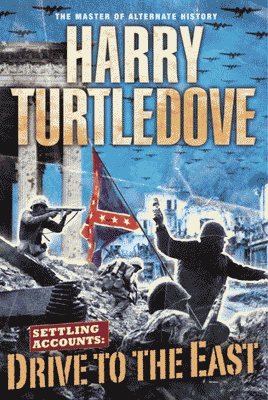
Settling Accounts: Drive to the East


Just last night, I finished reading Settling Accounts: Drive to the East by Harry Turtledove. Turtledove is the master of counterfactual historical fiction. In other words, Turtledove takes history, changes something about it, and then susses out how that might have made things different.

Drive to the East is the latest in a long series of books that Turtledove wrote along this counterfactual line: what if the Confederate States of America won the Civil War and became their own country? He started this series with How Few Remain (a book that I haven't read). I started reading when the series took up World War I. Turtledove reckoned that the South would be allied with Britain and France while the North would ally itself with the Kaiser in Germany.

Since I started reading this book, the North has won World War I, subjecting the Confederates to a crushing set of conditions for peace. They've also wrested Canada away from British control and occupied it. But what's truly interesting is what happened in the South. Embittered by the South's defeat in the Great War, a man named Jake Featherston wrote a scathing book in which he blamed the big-wigs in Richmond for the loss as well as the African American people (not the word used in any of these books) who rebelled against the CSA as well. Jake eventually joins a new political party, the Freedom Party, which eventually takes over the country with Jake as its president.

Yes, that's right, in this alternate timeline, the Nazis rise in the southern United States and then start World War II with the North.

When Drive to the East picks up, the offensive of the CSA had smashed through US lines, driving up through Ohio to Lake Erie, dividing the US in half. Now they're threatening to march east, eventually destroying Pittsburg. The USA has to counter that threat and quickly or else they'll lose the war.

The plot is a lot more complicated than that, of course. One thing about this series is that Turtledove slathers on the characters. I wouldn't say it's a cast of thousands, but it's pretty darn close! In some ways, it's understandable why he does that: you need that many people to keep up with all the action that takes place in this alternate time-line. You need someone to describe the war in the Pacific and Atlantic; you need people to describe the inner-workings of both the USA and CSA's governments. You need the perspective of the African American people who are rounded up and taken to concentration camps for "population reduction". The problem is, Turtledove piles on so many people that it's a little tricky to keep up with them all.

There were two other things that bothered me as I read this book. First of all, Turtledove is extremely repetitive in his writing. He kept using the same phrases over and over and over, often using them, almost word for word every other page. Worse, if one character had a massive revelation about something, you could almost guarantee that at least three others would have the exact same revelation within a dozen pages and that Turtledove would almost repeat it word for word.

The other thing that bothered me is that Turtledove seems to assume that his readers have very short memories. Perhaps its because he loads up his story with so many characters. It seemed like he had to expound on his characters' backstories every other time we encountered them. At the beginning of the book, that's helpful. It had been a while since I'd read one of his books in this series and I needed the refresher. But when I'm three-quarters of the way through the book, I don't need to be reminded for the fourth time that Yossel Rosen is Flora Blackford's nephew or that Sergeant Michael Pound has been in the Army since the Great War. I know that already.

But while I was annoyed with those two things, it's not enough to keep me from reading the next book in the series. After all, I need to see who figures out how to make a uranium bomb first, the US or the Confederates. My money's on the US, but with Turtledove, you just never know.

Monday, September 11, 2006

Inspiration Strikes

So I went for a haircut today and came away with an idea for a short story.

I've been putting off getting a trim for a while now. I wanted to time things so that I could get one right before I went to the ACFW conference so I could look my best. Problem is, my hair grew a little faster than I expected and it was beginning to bug me.

The man who normally cuts my hair is sick, so I decided I would try out a hairstyling place in downtown Blue Earth. As the lady got me ready and quizzed me about how I wanted things cut, I noticed her coffee mug:

Blessed are the hairstylists, for they bring out the beauty in others.

Uh huh. Don't remember that in the Beatitudes.

But as my hair was falling to the floor, the sentiment on the mug got me thinking. A hairstylist can certainly bring out the outer beauty in someone, but that usually won't lead to inner beauty. As a matter of fact, it would normally lead to....

Inspiration struck. I have at least the beginning of a short story. Now I just need to find an end for it.

Friday, September 08, 2006

Crown of Fire


I just finished reading the last of the Firebird trilogy, namely Crown of Fire.

Firebird's story concludes in this volume as she is called back to her homeworld of Netaia. Due to her older sister's abdication of the Netaian throne, Firebird will be confirmed as an heir in the Angelo family. But Firebird and Brennen are really setting a trap for their deadly enemies, the Shuhr, in hopes of destroying the threat of Three Zed.

At the same time, though, the Shuhr are setting an ambush of their own. Will Firebird, Brennen, and the Sentinels succeed with the Speaker's help? Or will the Shuhr destroy the only thing standing between them and complete domination of the Whorl?

No, I didn't steal that summary from the back cover of the book. It kind of stinks; I can sum up someone else's book, but write a synopsis for something I wrote and it's like pulling teeth....

I digress, sorry.

Like the other two books in this trilogy, Crown of Fire is excellent and sets the standard for all Christian sci-fi. Tyers does a masterful job blending faith with sci-fi. If you're looking for a great Christian story, you can't go wrong with the Firebird trilogy, especially since you can get all three books in one volume now. I just saw it at my local library today.

* * * *

One of my friends commented recently on my blog that I seem to be doing a lot of reading lately. That's true. I have been. I'm not exactly sure why. I suspect that part of the reason is because I'm trying to charge up my writing batteries. I've noticed (and I'm sure any authors who may have stumbled onto my little niche of the blogosphere can attest to this as well) that when I haven't read that much, I have a hard time writing.

Well, lately, I haven't been doing that much writing, even though I've been doing a lot of reading. I'm not sure what the problem is.

Part of it, I think, is the fact that I'm getting ready for the ACFW conference. I'll be pitching my own sci-fi trilogy, or at least the first book of it. Getting everything ready (one-sheets, business cards, four copies of a full proposal just in case) has been attention consuming, especially on top of my duties as a pastor.

Part of it is distraction from another situation that I can't discuss here. At least, not yet. How's that for suspense building?

Whatever the case, I think I took some good strides tonight. Jill and I went to Mankato to pick up my business cards for the conference and to release some books into the wild. As we were wandering the River Hills Mall, some elements dropped into place for a story that I've been mulling over for a while. I've also been doing some brainstorming on another Christian sci-fi book and I may be ready to start working on it. I'm even thinking of using the Snowflake Method to see if that will help.

Anyway, hopefully my super-saturation of literature over the past couple of weeks has helped me get ready for some great writing. We'll just have to wait and see.

Tuesday, September 05, 2006

We're Slowly Taking Over!

It's been an interesting 24 hours for me. If I were one to try to read into things, I'd think that perhaps Someone was trying to send me a sign.

As my profile says, I'm a proud member of The Lutheran Church - Missouri Synod. I've belonged to this denomination all my life and I can't imagine myself ever leaving. Well, that's not entirely true, but that's a discussion for another day.

As you also know if you've read my blog for a while, I'm also an unpublished author. Up until today, I thought that there weren't that many LCMS authors out there. 24 hours ago, I was aware of only one, Dr. Paul L. Maier, author of my favorite book. I always thought that if I were to be published, I would be a rarity: an LCMS author.

Turns out, we're not as rare as I thought.

Yesterday I sent out a mass e-mail update to my family and friends. I mentioned in the update that I would be attending the ACFW Conference in Dallas. Shortly thereafter, my Uncle Paul wrote back to me and said, "You know, the LCMS pastor in Fairmont (a town about twenty miles to the west of where I live) is a Christian author. He's had some stuff published."

I was stunned. I've met this man and never knew! So I did some digging and sure enough, there he was. I made a mental note that the next time I saw him, I'd have to pick his brains a little.

But the hits just keep on coming! Jill's Mom occasionally will send Jill articles from the Minneapolis paper or other sources. Today, Jill received a copy of the Concordia Academy - Bloomington Highlights, the newsletter of her high school alma mater. The front page story?

The Secret's Out: Author and Lancer alumna keeps focus on faith, faimly, in 'Secret Life of Bekcy Miller' novel

Turns out this lady wrote a speculative fiction piece about a daydreaming housewife. That piqued my interest. After all, speculative fiction is the broad umbrella term for stuff like sci-fi and fantasy, things I'm keenly interested in. I read about the "Mom-lit" book she wrote, but then I hit a paragraph that made me sit up and take notice:

Hinck plans to continue her writing and has additional books already in the works. Sharon's eyes light up when she speaks about the first book she wrote which will be published as part of the Restorer series by NavPress in June 2007. The series, with some analogies to the story of Deborah from the book of Judges, tells the story of a woman who is "pulled into a world waiting for a promised restorer."

I just about flipped. I had heard about this already! One of the wonderful folks in the ACFW forum, Mir, posted a story about how Jeff Gerke, then an editor at NavPress, acquired this book through Steve Laube, a literary agent. So I knew this speculative fiction book was in the works; I had no idea it was written by an LCMS author!

So I guess, if I'm fortunate enough to get published in the near or not-so-near future, that I won't be the only or even one of the few LCMS authors. But hey, that's all right. There's strength in numbers.

Fusion Fire


Late last night, I finished reading the second book of Kathy Tyers' Firebird trilogy, Fusion Fire. It actually kept me up later than I wanted or should have been up. I'm paying for finishing this great book today. A little sleepy.

This book continues the story of Lady Firebird from the first book. She has married the Sentinel who saved her at the battle of Veroh, Brennen Caldwell, and, as we join Firebird, we discover that she's pregnant with twin boys. But Tyers doesn't hesitate to thrust Firebird into danger. It turns out that Firebird and Brennen have been targeted by the Shuhr, the Sentinels' distant cousins who are not guided by the Sentinels' ethics. Think Sith to the Sentinel's Jedi, and you get the basic idea.

But the Shuhr aren't the only thing threatening Firebird's relationship. Firebird discovers she's carrying a horrendous secret, one that could steal all the happiness from her life, especially as Brennen travels to Three Zed, the home base of the Shuhr, to rescue Firebird's estranged sister, Phoena. Then there's the political machinations of occupied Netaia to deal with ... well, just writing about it makes me want to go home and start reading Crown of Fire, the last book of the trilogy. I won't, though, because I don't want another late night tonight.

This is a good continuation of the story and starts to build on the foundations forged in the first book. Since this is the second time I read it, I was surprised at how much I misremembered. I originally thought that the Shuhr were an invention of the second book. Having read Firebird, I realized that Tyers dropped some major hints about their involvement in the storyline. I also had to wrestle with sympathy for a character named Ellet Kinsman. Before I reread Fusion Fire, I thought she wound up badly abused in the story. Now I have little sympathy for her. Read the book; you'll probably see what I'm talking about.

What resonated most strongly for me was Firebird's struggle with the concept of evil. It's not just the big quesiton of "Why does God permit evil?", although Firebird certainly dives into that philosophical tangle. Firebird must also struggle with the more personal question of "Am I evil?" That resonated quite strongly for me. I mean, hey, I'm a pastor, I know what the Bible says about original sin and such, but even I have to admit that I'd rather think that I'm a good guy deep, deep down. Firebird struggles with that idea as well and it helps move the plot along.

Rereading this book also makes me curious. Like I said, the first two books of this trilogy were originally written as secular science fiction. Tyers was able to go back and weave Christian concepts more tightly into the plot and republish them. I've only read the Christian version. After seeing how tightly woven Christian concepts are into this story, it makes me wonder what the original looked like. I'm not sure I'd be able to find an original version, nor am I sure I'd really want to read it. It just has me curious.

Anyway, one more Firebird story to go. At least, one more to go before Kathy finishes her current work-in-progress. Then I guess I'll have to look forward to more sleepless nights.

Friday, September 01, 2006

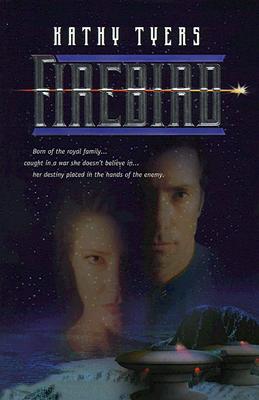
Firebird

(AKA Trojan Horse for the Force Part II)


As promised, I went back after finishing DragonKnight and I've started Kathy Tyers' Firebird trilogy, starting with, appropriately enough, Firebird. Like I said before, this book is the reason I read Christian Sci-Fi/Fantasy at all. Simply put, this is one of the best.

Firebird is the story of Firebird Angelo, the third-born daughter of the ruling family of a planet called Netaia. Because of her position in her family, Firebird is what's known as a "wastling". She is a back-up heir for her mother, the queen of Netaia. Should anything happen to her two older sisters, Firebird would be able to assume the throne. But as soon as her older sister, Carradee, gives birth to her second daughter, Firebird's life is forfeit and she will be expected to die for Netaia. In Firebird's case, this death will come during an invasion of a planet called Veroh.

Firebird's plans, however, don't work out when she is captured by Veroh's defenders, members of the Federacy, a galaxy-spanning government. More specifically, she's captured by Brennen Caldwell, an ace pilot on the fast track to the High Command of the Federacy. Brennen is also a Sentinel, a member of an ancient and somewhat secretive religious order. Brennen surprises Firebird by not only treating her with great dignity and respect, but by insisting that she not throw her life away for Netaia. Why would he do that?

Well, you're gonna need to read the book to find out!

The one thing I noticed during this second re-reading is how closely parallel some of the concepts of this story are to another epic space opera set a long time ago in a galaxy far, far away. The Sentinels especially sound like Christianized Jedi more than once. But that's not necessarily a bad thing; it gives readers a "point of contact" that allows them to slip into the story a bit easier. They're dealing with familiar concepts with a not-so-subtle twist. Hence my "Trojan Horse for the Force" comment.

Tyers does a marvelous job working with this story and she really captures the emotional content of Firebird's journey from death to new life. You won't be disappointed with this one.

As for me, now it's on to the next book, Fusion Fire.

Accepted

Tonight, Jill and I had to take a trip to Fairmont to get her a new cell phone. Hers died last weekend, most likely because her contract expired and the phone company wanted us to buy a new one. So we decided as long as we were in town, we might as well take in a movie.

The movie we took in was Accepted. In the interest of all fairness, I went into this with very low expectations. Sure, the commercials looked funny, but that's the job of advertising executives. The fact that the previews included one for a certain movie made me worried that what we were about to see was going to be very, very low-brow.

In some ways, it was. I mean, all you have to do is consider the name of the fake college that's created by our intrepid hero, Bartleby Gaines (yes, that's his real name): the South Harmon Institute of Technology. Well, maybe not the name. The initials then. Figure it out yourself. They make liberal use of the initials almost to the point of eye rolling.

There were also some logical lapses in the plot, which in some ways was entirely predictable. I know one of my faults is that I overanalyze movies too much, but there was one glaring plot hole that just did not make sense to me at all. After careful consideration, I won't share what it is. It does kind of give away big chunks of the early plot, so I'll leave it to my intrepid readers to suss out what the plot hole was.

But now onto why I left the theater with a big smile on my face. First of all, the movie was fun. It was. Predictable or not, the story was a fun ride. I'll give you an example to look forward to. If you're paying attention, you won't be all that surprised by the way the movie ends. But it was still a great ending nonetheless.

Second, Justin Long did a fantastic job in this movie. At least, I thought he did. He evoked a sort of new millennium Ferris Bueller in his performance. He did seem to rely on slapstick gags a bit too much, but it was enough to truly drive me bonkers. It's almost enough for me to overlook those abominable Mac commercials.

Third, Lewis Black was a stitch every time I saw him. Loads of fun.

So there you go. Fun movie, go and see it.

Wednesday, August 30, 2006

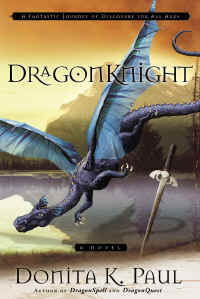
DragonKnight


So I've now finished the third of Donita K. Paul's dragon books, DragonKnight.

Instead of following the story of Dragon Keeper Kale Allerion, this story follows Squire Bardon, a character introduced in the last book. Bardon sets off on a sabbatical, a time for him to spend in seclusion to decide whether or not he wants to dedicated himself to the service of Paladin. But as soon as he arrives at the secluded cabin he's supposed to live in, he finds himself thrown into a quest with three women to save a group of knights held captive by an evil wizard's spell. Bardon reluctantly agrees to put his sabbatical on hold while he tries to help the women.

Soon Bardon's troubles grow as more and more people are added to the questing party. But on the way, he learns more and more about himself and who he really is. Trust me, if you read all three books, you'll understand what that's about.

I thought this was simply a phenomenal book, perhaps the best out of the three. You know those little gripes I had about the second book? They're not in this one. The story was a great read and actually kept me up late last night as I kept thinking, "One more chapter before I go to sleep. One more chapter! Oh, I have time for just one more."

So if you're in the mood for a great fantasy adventure, this is definitely one to read.

Friday, August 25, 2006

A Trip to Barnes and Noble

So this afternoon I went to Barnes and Noble. I did my usual swing through the Christian fiction section but didn't see anything that caught my attention (the usual lack of sci-fi/fantasy. Hopefully that will change soon!). I moved on to the regular sci-fi/fantasy section where I picked up Harry Turtledove's Settling Accounts: Drive to the East. I'll add it to the pile (which I think includes Kathy Tyer's Firebird trilogy and Karen Hancock's Legends of the Guardian King books).

On my way out, I went through the new books section and noticed the novel version of John Cena's upcoming movie, The Marine. Fair enough. It was what was sitting next to it that made me cringe:

Seriously. What the heck is this? Torrie Wilson holding a gun? Before I knew what was happening, the book was in my hand and I turned it over to read the back to see what this was about. This is what I learned:


December 2001: Vince McMahon steps out of a snowy night into a diner in upstate New York for a meeting with old friend Phil Thomson, now a highly placed government official. Thomson has a strange proposition: creating a new covert black-ops group using the Superstars of World Wrestling Entertainment. The WWE's talented men and women are perfect. Highly skilled athletes with the ideal cover, they travel all across the country and the globe; no one would find it unusual to find them in a town one day and gone the next. The government would train and support the wrestlers in every way possible except one: no one must know the truth.

March 2006: The Superstars have been handed their latest assignment -- take down a commercial-grade methyl-amphetamine plant that is bankrolling terrorist activities in Europe. Their mission seems simple and straightforward, until a member of their team is taken prisoner. Now all that they've worked so hard for is in jeopardy, and one of their own might be killed...

Seriously. I am not making this up. What scares me even more is the fact that people gave it such positive reviews. A few might be sarcastic, but really.

I guess the one nice thing about this fiasco is this: Yes, this travesty was published by WWE Books. But if this can get published, then I have to have a good shot. Heck, maybe they'll need some help with the sequel. Vince, call me!